
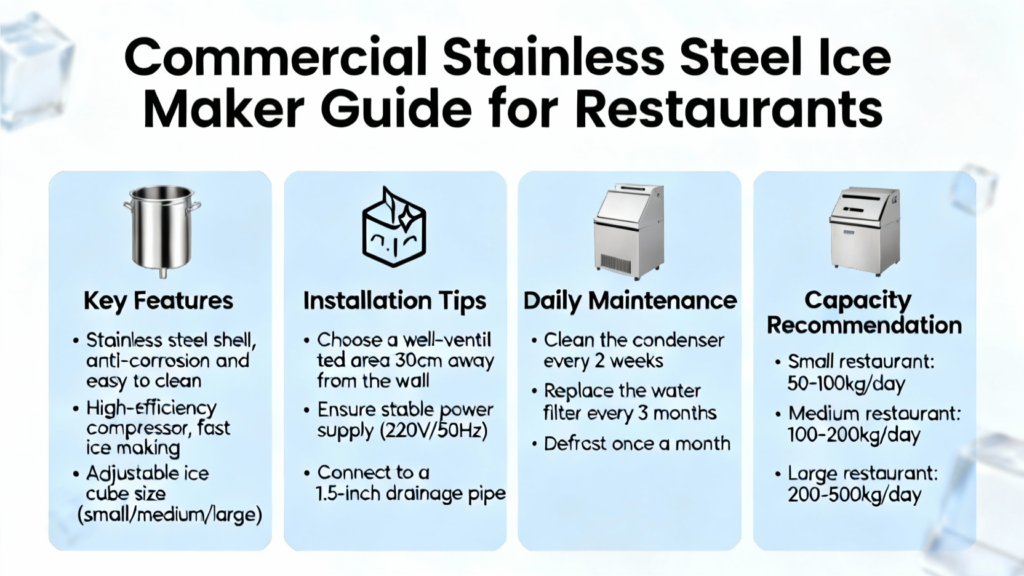
For restaurants, bars, and hotels, a reliable ice supply is non-negotiable. This guide delves into the specifications, installation, and safety protocols for a heavy-duty commercial ice maker built with durable stainless steel. We’ll cover its operational requirements, optimal setup, and critical safety notes to ensure peak performance and longevity in your business.
Engineering and Specifications for Demanding Environments
This commercial ice maker is engineered for resilience, featuring a durable stainless steel construction that resists corrosion and withstands the rigors of a busy kitchen or bar. Its design for 110V 60Hz operation with 780W power consumption makes it compatible with standard US commercial outlets. A key modern feature is its use of environmentally friendly R290 (propane) refrigerant. According to Wikipedia, R290 has a “negligible ozone depletion potential and very low global warming potential” compared to traditional hydrofluorocarbons, making it a more sustainable choice, though it requires specific handling due to its flammability. The unit’s compatibility with climate types SN, N, and ST ensures reliable ice production across varied temperature environments common in commercial settings.
Proper Installation and Site Preparation
Correct installation is paramount for safety and efficiency. The unit requires a drinking water supply with a pressure between 14.5-58 psi; outside this range, a pressure changeover valve is mandatory. As highlighted in user discussions on Reddit, improper water pressure is a frequent cause of machine malfunction. A user in a 2023 r/refrigeration thread emphasized, “Always check incoming water pressure… too high and you’ll blow seals, too low and it won’t fill properly.” Furthermore, the unit needs at least 5.9 inches of clearance on all sides for airflow and must be positioned with its drainage port connected to a line where the outlet is lower than the machine, allowing wastewater to discharge by gravity.
Critical Safety and Initial Startup Protocols
Adhering to safety guidelines prevents hazards and ensures operational integrity. Key mandates include:
- Never using an extension cord, as it may overheat and pose a fire risk.
- Keeping the unit away from flammable materials and heat sources like stoves.
- Using only water to make ice; other liquids can damage the system.
- Allowing the unit to settle upright for 24 hours after delivery before initial plug-in, and then waiting an additional hour for the refrigerant to settle before starting. This prevents compressor damage, a point often stressed in appliance manuals.
These steps are not mere suggestions; they are essential for warranty compliance and safe operation. For a reliable unit built to these standards, consider the commercial stainless steel ice maker designed for heavy-duty use.
Optimizing Performance and Long-term Operation
To maintain consistent ice production, understand the factors within your control. The machine is for indoor use only and should be kept out of direct sunlight, as ambient temperature directly influences ice-making cycle times. The unit is equipped with a 70-inch three-prong power cord for proper grounding. Remember that ice in the storage bin will naturally melt, so the drain connection must remain clear. Regular cleaning and maintenance, as per the manufacturer’s instructions, are crucial. Resources like Wikipedia’s entry on Ice machines detail the common maintenance cycles needed to prevent scale buildup and bacterial growth, which are vital for any foodservice operation.
In summary, integrating a heavy-duty commercial ice maker into your business requires careful attention to its technical specifications, site preparation, and strict safety protocols. From ensuring the correct water pressure and clearance for installation to following critical startup procedures like the 24-hour settling period, each step lays the foundation for reliable performance. The use of R290 refrigerant reflects a move toward environmental responsibility, while the stainless steel construction promises durability. Ultimately, the machine’s output and lifespan depend on a commitment to proper operation and preventative maintenance. By understanding and implementing these guidelines, you can secure a consistent, high-quality ice supply that meets the demands of your customers and supports the smooth operation of your restaurant, bar, or hotel.
This guide is a great reminder that a reliable commercial ice maker is truly the backbone of a busy restaurant’s drink service.
\}}
This guide is a great reminder that a reliable commercial ice maker is truly the backbone of a busy restaurant’s drink service.
\}}
This guide is a great reminder that a reliable commercial ice maker is truly the backbone of a busy restaurant’s drink service.
\}}
This guide is a great reminder that a reliable commercial ice maker is truly the backbone of a busy restaurant’s drink service.
\}}
This guide is a great reminder that a reliable commercial ice maker is truly the backbone of a busy restaurant’s drink service.
\}}
This guide is a great deep dive into the key specs and setup for a durable commercial ice maker, which is such a crucial piece of equipment for any busy restaurant.
\}}
This guide is a great deep dive into the key specs and setup for a durable commercial ice maker, which is such a crucial piece of equipment for any busy restaurant.
\}}