
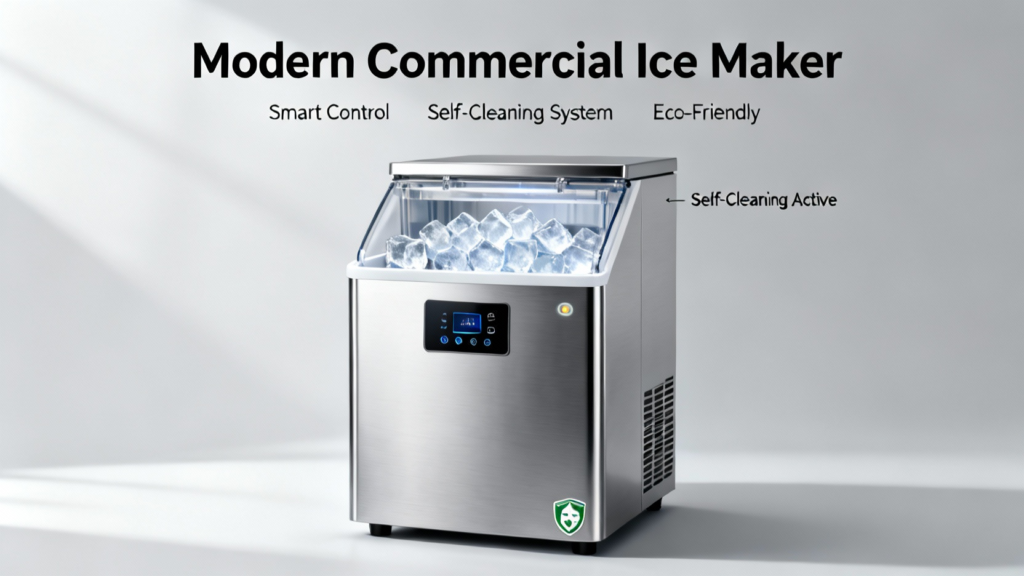
In today’s market, a commercial ice maker must be more than just powerful; it must be intelligent, efficient, and adaptable. This article explores the advanced features of modern ice makers, focusing on how innovations like self-cleaning programs, eco-friendly refrigerants, and versatile installation are redefining reliability and performance for both commercial and high-demand residential settings.
The Core of Clean Ice: Filtration and Automated Maintenance
At the heart of any quality ice maker is its ability to produce pure, clean ice consistently. This begins with an integrated water filtration system, which removes impurities that can affect taste and clarity. More importantly, the self-cleaning program represents a significant leap in maintenance technology. By automating the descaling and sanitization process, it ensures optimal hygiene and machine longevity, eliminating the downtime and labor associated with manual cleaning. This is critical in commercial environments where equipment reliability is paramount, as noted in discussions on restaurant industry subreddits where maintenance woes are a frequent topic.
Intelligent Operation and Unmatched Capacity
Modern units are defined by smart features that provide both convenience and control. The reservation function allows for precise scheduling, ensuring ice production aligns with peak demand periods, while the defrost cycle maintains efficiency. When paired with a massive daily output of over 10,000 cubes and a spacious storage bin holding up to 60 lbs., these features make a machine like the Tittla 24″ Built-In Filter Ice Maker a powerhouse for events or high-volume service. Producing up to 126 cubes per cycle means never running low during critical times.
Sustainable Design and Flexible Installation
The environmental impact of refrigeration is a growing concern. Leading manufacturers are now adopting eco-friendly R290 refrigerant (propane), which has a significantly lower global warming potential (GWP) compared to traditional hydrofluorocarbons (HFCs). As detailed on Wikipedia’s entry for R290, this natural refrigerant is gaining favor for its efficiency and reduced environmental footprint. This sustainable choice is complemented by versatile built-in or freestanding mounting options, allowing for seamless integration into any kitchen layout, with durable stainless steel components ensuring both style and longevity.
Conclusion: The Benchmark for Modern Ice Production
Choosing a commercial ice maker today requires evaluating a suite of interconnected features that go beyond simple output. As we have explored, the journey begins with ensuring purity through filtration and is revolutionized by automated self-cleaning, a feature that addresses a core pain point in the industry. Intelligent scheduling and defrost functions then layer on operational control, maximizing the immense potential of a machine capable of producing over 10,000 cubes daily and storing 60 pounds. This capacity meets the direct needs highlighted in hospitality forums, where volume and reliability are non-negotiable.
Furthermore, the commitment to sustainability through refrigerants like R290 reflects a responsible approach to manufacturing, aligning with global environmental standards. Finally, the flexibility of installation, whether built-in for a streamlined look or freestanding for convenience, capped with durable stainless steel construction, ensures the unit is a lasting investment. When all these elements—hygiene, intelligence, capacity, eco-design, and adaptability—converge in a single unit, such as the featured model, it sets a new benchmark. It delivers not just ice, but dependable, clean, and efficiently produced ice tailored to the rigorous demands of any business or large household.
It’s impressive how modern commercial ice makers now come with smart features like self-cleaning programs, making them both efficient and eco-friendly.
\}}
It’s impressive how modern commercial ice makers have evolved to be so smart and eco-friendly.
\}}
It’s impressive how modern commercial ice makers have evolved to be so smart and eco-friendly.
\}}