
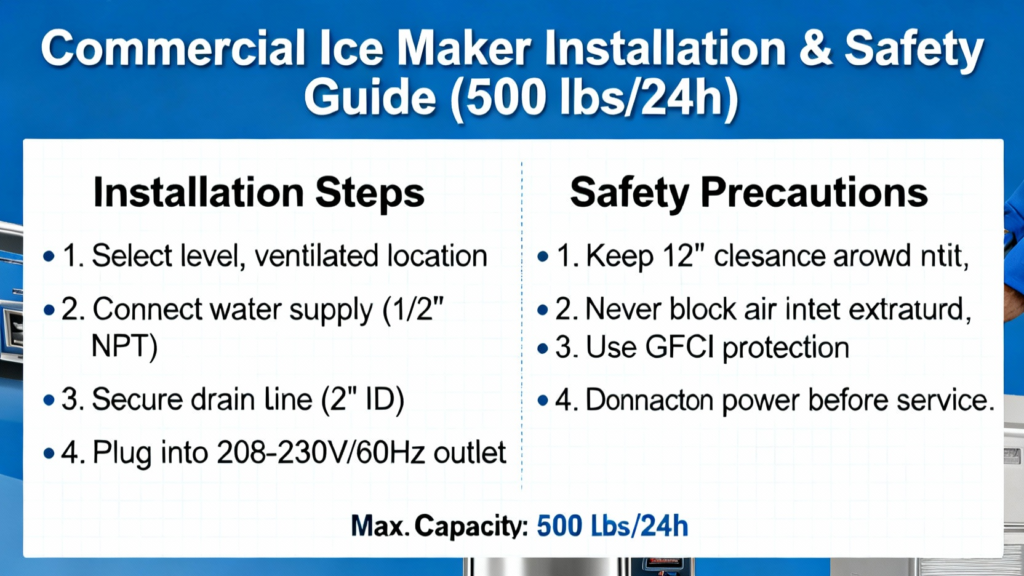
For restaurants, bars, and hotels, a reliable ice maker is the backbone of service. This guide explores the key features, essential installation requirements, and critical safety protocols for operating a heavy-duty 500 lbs./24h capacity commercial ice maker. Understanding these elements is crucial for maximizing performance, ensuring longevity, and maintaining the highest standards of operational safety in your business.
Engineering for Endurance: Core Features of a Commercial Ice Maker
Built for the relentless demands of foodservice, a true commercial ice maker like the 23.2 in. 500 lbs./24h Capacity Commercial Stainless Steel Ice Maker is defined by robust construction. The durable stainless steel exterior is not just for aesthetics; it resists corrosion, withstands frequent cleaning, and maintains hygiene—a non-negotiable in the industry. Internally, the use of environmentally friendly R290 (propane) refrigerant is a significant advancement. As noted in discussions on refrigerant phases, R290 has a low Global Warming Potential (GWP) and is efficient, though it requires specific safety considerations during servicing[Reddit, 2023]. Compatibility with multiple climate types (SN, N, ST) ensures the unit can maintain its 500 lbs./24h output across varied ambient temperatures, a critical factor for consistent operation.
Pre-Installation: Site Readiness and Safety Foundations
Proper installation is the first step toward reliable operation. The unit requires a dedicated drinking water supply with precise pressure (14.5-58 psi) and a gravity-fed wastewater drain. Critical spatial requirements include at least 6 inches of clearance on all sides for airflow, which prevents compressor overheating and maintains efficiency. Electrical safety is paramount: the included three-prong plug must connect to a properly grounded 110V/60Hz outlet. Extension cords are prohibited due to the 780W power draw, as they can overheat and pose a serious fire risk, a point consistently emphasized by electrical safety authorities. Furthermore, the unit must be placed away from heat sources and direct sunlight, which can force the compressor to work harder, increasing energy consumption and wear.
Initial Startup and Operational Best Practices
Upon delivery, a crucial waiting period is required. After transport, the unit must stand upright for 24 hours before being plugged in. This allows the compressor oil, which may have shifted during transit, to settle back into the compressor, preventing severe damage upon startup—a standard protocol for refrigeration equipment. For initial use, an additional hour is recommended for the refrigerant to stabilize. Operationally, only potable water should be used. Introducing other liquids can damage the internal water system, alter ice quality, and create health hazards. It’s also important to understand that ice production time is ambient temperature dependent; the machine will cycle more frequently in a hot kitchen, which is normal for its climate-compensating design.
Long-Term Reliability and Maintenance Considerations
Ensuring the longevity of your commercial stainless steel ice maker hinges on proactive maintenance. The continuous melt-water drainage system requires an unobstructed pipe, with the outlet lower than the machine’s port to ensure proper gravity flow and prevent internal water accumulation. Regular cleaning and sanitizing, as per the manufacturer’s schedule, are essential to prevent scale buildup and biological contamination, which can degrade performance and ice quality. The principle of refrigeration, as defined by the vapor-compression cycle, relies on unimpeded heat exchange[Wikipedia]. Therefore, keeping the condenser coils clean and ensuring adequate ventilation directly supports the machine’s efficiency and achieves its rated production capacity over years of service.
Conclusion
Investing in a heavy-duty commercial ice maker is a significant decision that impacts daily operations. This guide has detailed the journey from understanding its durable stainless steel construction and efficient R290 refrigerant system to executing a correct installation with proper water, drain, and electrical connections. We’ve underscored the non-negotiable safety steps, like the 24-hour settling period and the absolute avoidance of extension cords, and outlined the operational realities, such as ambient temperature effects on production cycles. Ultimately, the reliable performance and longevity of a 500 lbs./24h capacity unit are not just about its built specifications, but about the commitment to following these installation and maintenance protocols. By treating your ice maker as the critical piece of commercial equipment it is, you secure a dependable supply of ice—ensuring customer satisfaction, supporting food safety, and safeguarding your investment for the long term. Proper care transforms a powerful machine into the dependable workhorse your business can count on every day.
Great guide—getting the installation and safety right for a 500 lbs./24h ice maker is definitely the key to keeping service running smoothly.
\}}
Great guide—getting the installation and safety right for a 500 lbs./24h ice maker is definitely the key to keeping service running smoothly.
\}}
Great guide—getting the installation and safety right for a 500 lbs./24h ice maker is definitely the key to keeping service running smoothly.
\}}
Great guide—getting the installation and safety right for a 500 lbs./24h ice maker is definitely the key to keeping service running smoothly.
\}}
Great guide—getting the installation and safety right for a 500 lbs./24h ice maker is definitely the key to keeping service running smoothly.
\}}
This guide really highlights why understanding the installation and safety protocols is so crucial for a reliable 500 lbs./24h ice maker.
\}}
This guide really highlights why understanding the installation and safety protocols is so crucial for a reliable 500 lbs./24h ice maker.
\}}
This guide really highlights why understanding the installation and safety protocols is so crucial for a reliable 500 lbs./24h ice maker.
\}}
This guide really highlights why understanding the installation and safety protocols is so crucial for a reliable 500 lbs./24h ice maker.
\}}
This guide really highlights why understanding the installation and safety protocols is so crucial for a reliable 500 lbs./24h ice maker.
\}}