
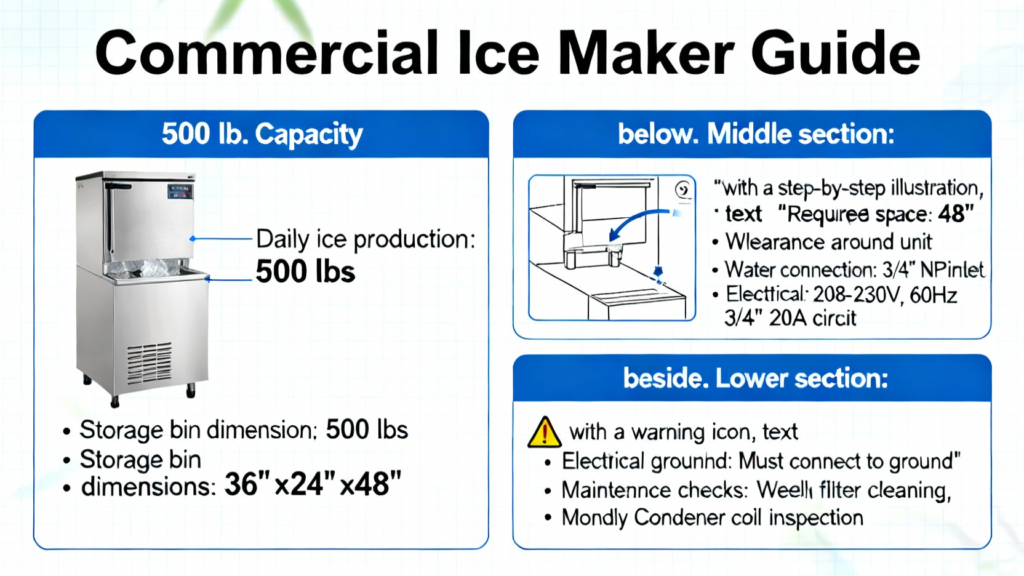
For restaurants, bars, and hotels, a reliable ice maker is a cornerstone of daily operations. This guide delves into the critical specifications, optimal installation practices, and essential safety protocols for a heavy-duty 500 lb./24h capacity commercial ice maker. Understanding these elements is key to ensuring peak performance, longevity, and safety in your foodservice business.
Engineering for Commercial Endurance
Built with durable stainless steel construction, this ice maker is designed for the rigors of high-volume use. Its compatibility with climate types SN, N, and ST ensures reliable performance across varied environments, from consistently cool to seasonally hot temperatures common in commercial kitchens. The use of environmentally friendly R290 (propane) refrigerant is a forward-thinking choice, as it has a significantly lower Global Warming Potential (GWP) compared to traditional HFCs. Operating on a standard 110V/60Hz circuit with 780W power draw makes it accessible for most US commercial settings without requiring specialized electrical upgrades.
Strategic Installation for Peak Performance
Proper installation is not just about placement; it’s about ensuring efficiency and preventing malfunctions. The unit requires a dedicated drinking water supply with a pressure between 14.5-58 psi, necessitating a pressure regulator if outside this range. Critical clearance of at least 5.9 inches on all sides is mandated for adequate airflow, preventing compressor overload and premature failure. Furthermore, as emphasized in a Reddit discussion by a refrigeration professional in November 2023, allowing a unit to settle upright for 24 hours after delivery is non-negotiable to let compressor oil settle, preventing immediate damage upon startup.
Operational Safety and Essential Protocols
Adhering to safety guidelines protects both your staff and your investment. The ice maker’s three-prong plug must be connected to a properly grounded outlet; using an extension cord is strongly discouraged due to overheating and fire risk. The unit must be kept away from flammable materials, direct sunlight, and heat sources like stoves. It is designed for indoor use only, as outdoor conditions can lead to electrical hazards and performance issues. Importantly, only potable water should be used, as other liquids can damage the internal system and contaminate ice.
Maintenance and Water Management
Long-term reliability hinges on correct water and waste management. The unit requires a gravity-fed drain connection, with the outlet positioned lower than the machine’s drainage port, to efficiently handle meltwater and internal discharge. Failure to do this can result in water accumulation and ice blockages. Users should also note that ice production times can vary with ambient room temperature—a hotter environment means the compressor works harder, potentially slowing output. Regular cleaning and descaling, as per the manufacturer’s schedule, are also vital to maintain ice quality and machine health.
In summary, maximizing the return on your commercial ice maker investment requires a holistic approach that extends beyond simply plugging it in. From understanding its engineered durability and climate compatibility to executing a precise installation with proper clearances and water pressure, each step sets the stage for reliable service. Rigorous adherence to safety protocols—like avoiding extension cords and allowing proper settling time—is crucial for operational integrity. Finally, proactive maintenance through correct drainage and regular cleaning ensures consistent ice production and equipment longevity. For businesses seeking a robust solution, a unit like the 23.2 in. 500 lbs./24h Capacity Commercial Stainless Steel Ice Maker represents a significant asset when its capabilities are supported by informed installation and care. By integrating these technical, safety, and maintenance principles, you secure a dependable ice supply that supports seamless daily operations in your restaurant, bar, or hotel.
This guide is a must-read for anyone considering a heavy-duty 500 lb. commercial ice maker, as proper installation and safety are so important.
\}}
This guide is a must-read for anyone considering a heavy-duty 500 lb. commercial ice maker, as proper installation and safety are so important.
\}}
This guide is a must-read for anyone considering a heavy-duty 500 lb. commercial ice maker, as proper installation and safety are so important.
\}}
This guide is a must-read for anyone considering a heavy-duty 500 lb. commercial ice maker, as proper installation and safety are so important.
\}}
This guide is super helpful for understanding the installation and safety of a heavy-duty 500 lb. commercial ice maker, which is a total game-changer for busy kitchens.
\}}
This guide is super helpful for understanding the installation and safety of a heavy-duty 500 lb. commercial ice maker, which is a total game-changer for busy kitchens.
\}}
This guide is super helpful for understanding the installation and safety of a heavy-duty 500 lb. commercial ice maker, which is a total game-changer for busy kitchens.
\}}
This guide is super helpful for understanding the installation and safety of a heavy-duty 500 lb. commercial ice maker, which is a total game-changer for busy kitchens.
\}}