
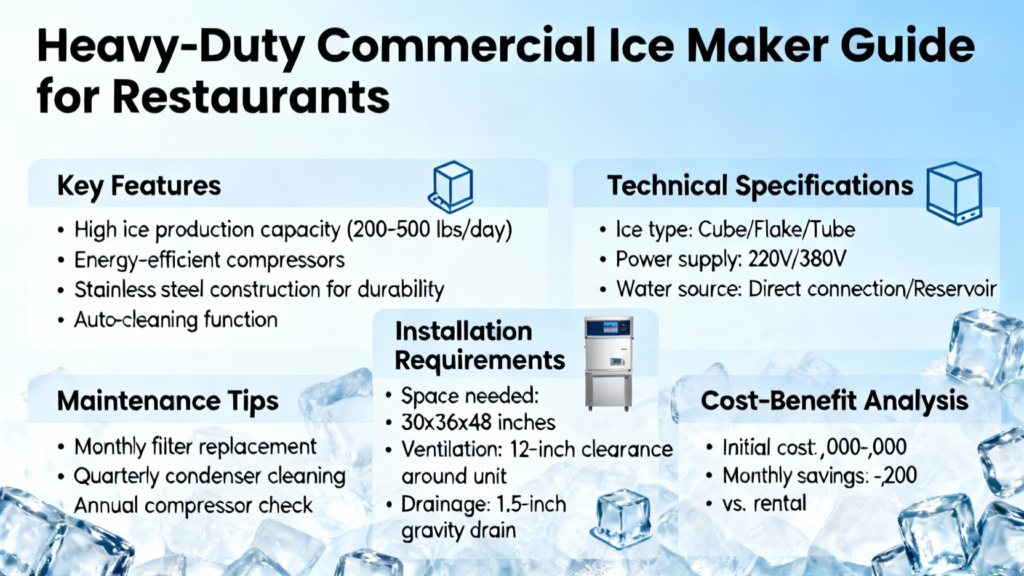
For restaurants, bars, and hotels, a reliable ice maker is the backbone of service. This guide delves into the Heavy-Duty Commercial Ice Maker, exploring its durable stainless steel construction, key operational requirements, and critical safety and installation protocols to ensure optimal performance and longevity in a demanding commercial environment.
Engineering for Endurance: Stainless Steel and R290 Refrigerant
At the core of this ice maker’s reliability is its durable stainless steel construction. This material is industry-standard for commercial kitchens due to its exceptional corrosion resistance, ease of cleaning, and structural integrity under constant use. Paired with this is the use of environmentally friendly R290 refrigerant. R290, or propane, is a natural refrigerant with a very low Global Warming Potential (GWP). As noted on Wikipedia, natural refrigerants like hydrocarbons are gaining favor as alternatives to synthetic refrigerants due to their environmental benefits and energy efficiency, though they require specific safety considerations during handling.
This robust build is designed for 110V 60Hz operation, making it compatible with standard US commercial power outlets, and its compatibility with climate types SN, N, and ST ensures reliable performance across varied environmental conditions common in North America.
Critical Installation and Setup Protocols
Proper installation is non-negotiable for performance and safety. The unit requires a direct drinking water supply connection with a specific water pressure range of 14.5-58 psi. Pressure outside this range necessitates a changeover valve to prevent mechanical issues. Furthermore, a gravity-fed drain pipe must be connected before operation, with its outlet lower than the machine’s to handle meltwater discharge efficiently.
Physical placement is equally crucial. The manual mandates at least 5.9 inches of clearance on all sides for adequate airflow, which is essential for heat exchange and compressor longevity. As discussed in commercial kitchen subreddits like r/KitchenConfidential, improper ventilation is a common cause of equipment failure. After delivery, the unit must remain upright for 24 hours to allow compressor oils to settle, a standard but vital step for any refrigeration equipment after transport.
Operational Safety and Best Practices
Adhering to safety guidelines protects both personnel and the equipment. The ice maker comes with a three-prong plug and a 70″ power cord, and using an extension cord is strongly discouraged as it can overheat and pose a fire risk. It must be kept away from flammable materials and heat sources like stoves or direct sunlight, which can also impair efficiency.
Operational limits are clear: the unit is for indoor use only and designed solely for use with water. Introducing other liquids can damage the system and contaminate ice. Users should also understand that the surrounding environmental temperature influences ice-making time, with higher ambient temperatures typically slowing production.
Selecting the Right Machine for Your Business
When evaluating commercial ice makers, matching capacity and build to your operation’s volume is key. This model, with its substantial output and footprint (26.4 × 23.2 × 61.4 in), is engineered for high-demand settings. For operations requiring a balance of high capacity and a slightly different form factor, exploring options like the 23.23 in. 750 lbs./24h Capacity Commercial Stainless Steel Ice Maker is advisable. Investing in a properly sized, professionally installed commercial stainless steel ice maker is an investment in seamless daily service.
In summary, maximizing the return on a heavy-duty commercial ice maker hinges on understanding its engineering, respecting its installation requirements, and adhering to strict operational safety. The durable stainless steel construction and R290 refrigerant system form a robust foundation for high-volume ice production. However, this potential is only realized with correct setup: ensuring proper water pressure and drainage, allowing for critical clearance and settling time, and following electrical safety protocols to the letter. As evidenced by discussions among industry professionals and technical resources, neglecting these steps is a primary cause of premature equipment failure. Ultimately, a model like this, or a comparable unit such as the 23.23 in. 750 lbs./24h Capacity Commercial Stainless Steel Ice Maker, is not just an appliance but a critical component of your business infrastructure. By prioritizing informed installation and diligent operation, you secure a reliable supply of ice, ensuring your bar, restaurant, or hotel can run smoothly and serve customers without interruption.
This guide really highlights why a heavy-duty commercial ice maker is such a crucial investment for keeping service running smoothly.
\}}
This guide really highlights why a heavy-duty commercial ice maker is such a crucial investment for keeping service running smoothly.
\}}
This guide really highlights why a heavy-duty commercial ice maker is such a crucial investment for keeping service running smoothly.
\}}
This guide really highlights why a heavy-duty commercial ice maker is such a crucial investment for keeping service running smoothly.
\}}
This guide really highlights why a heavy-duty commercial ice maker is such a crucial investment for keeping service running smoothly.
\}}
This guide is super helpful for understanding the key requirements and safety protocols for a heavy-duty commercial ice maker.
\}}
This guide is super helpful for understanding the key requirements and safety protocols for a heavy-duty commercial ice maker.
\}}
This guide is super helpful for understanding the key requirements and safety protocols for a heavy-duty commercial ice maker.
\}}
This guide is super helpful for understanding the key requirements and safety protocols for a heavy-duty commercial ice maker.
\}}
This guide is super helpful for understanding the key requirements and safety protocols for a heavy-duty commercial ice maker.
\}}